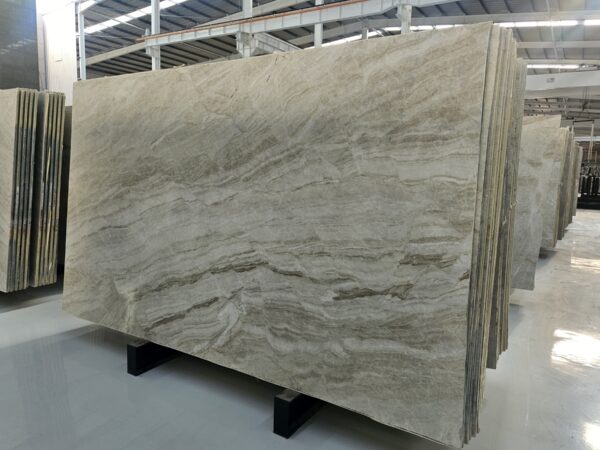
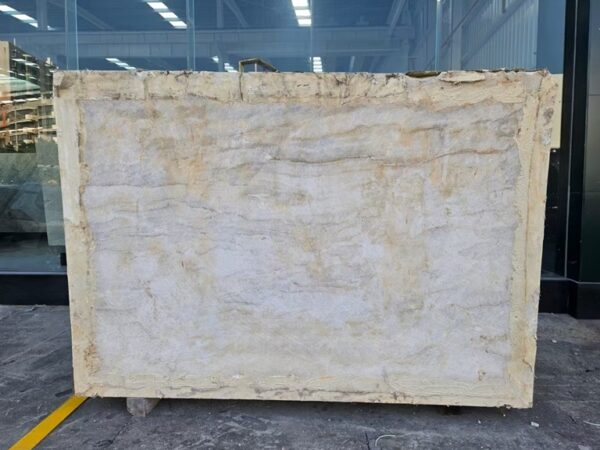
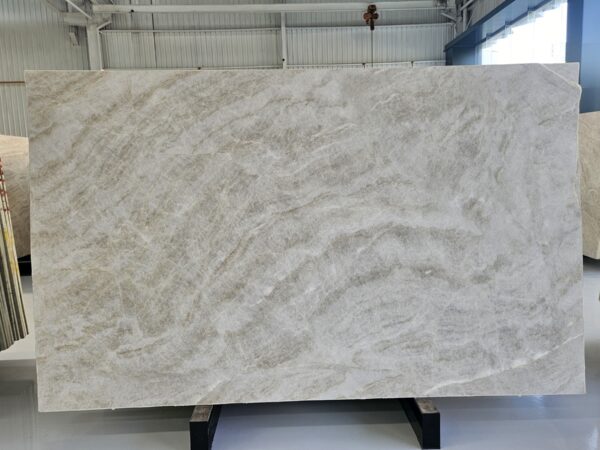
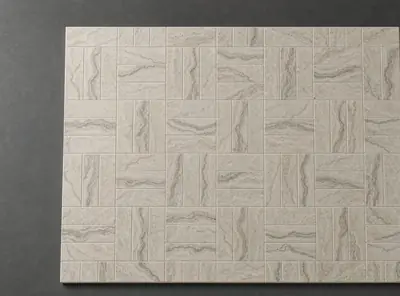
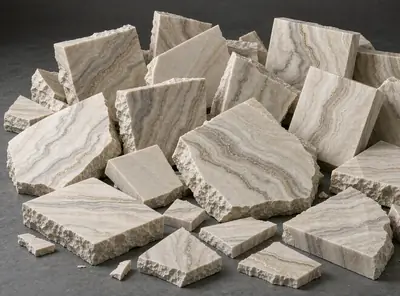
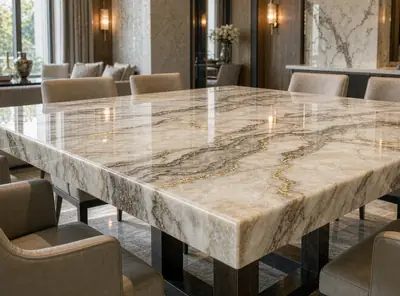
Bought at the mine by the large-scale buyers, held in stock at every grade, cut by smart factories, and shipped from whichever Chinese port suits you best. Taj Mahal Quartzite came from a Brazilian quarry and most buyers arrive assuming an Indian one, so we tell you what you are actually looking at before you ask us to quote it.
We buy Taj Mahal Quartzite through the large-scale quarriers that work the Brazil blocks directly, and we buy across both the Shuitou and Yunfu clusters. Volume is what creates the price — and that volume is ours, not yours to negotiate alone.
Commercial, select, premium and bookmatch — and the grade names describe veining density and background warmth, not price tiers bolted on afterwards. At 0.14% absorption this stone takes a sealer far less often than a porous stone, which means a lobby slab and a kitchen slab come from the same lot without the maintenance profile changing between them. What actually moves between grades here is how much the warm beige veining reads across a large surface, which is a room question and not a budget question.
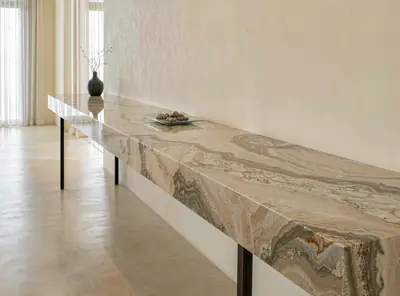
Taj Mahal Quartzite carries a linear veining, so nesting decides whether a run reads as one movement or as a row of separate pieces. We lay the parts out against the actual slab before the wire saw starts, which is what turns a kitchen elevation from eleven matching-looking-but-not pieces into a run. The same nesting is what lets us tell you the yield before the block is opened rather than after.
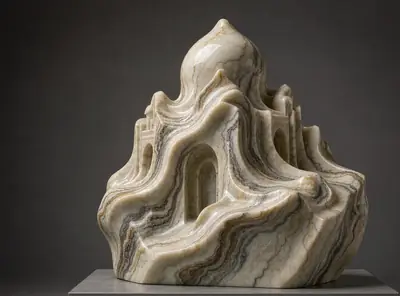
Stone is a craft before it is a commodity. We work with the designers and fabricators who understand how Taj Mahal Quartzite should be laid out, cut and finished — so the job looks right, not just measurable.
Our people are at the factory while the work is being made — not only when the container is full. Grade, thickness, calibre, veining and polish are checked and photographed batch by batch.
Taj Mahal Quartzite runs about 2.65 g/cm3, which is heavier per square metre than a limestone and decides the shipping arithmetic before it decides the freight quote. A 20 mm slab is close to 55 kg, so a standard container is limited by how many slabs fit flat rather than by how many it will hold. Xiamen sits closest to Shuitou, but we ship from whichever port serves your lane — Xiamen, Quanzhou, Ningbo or Shanghai — and we quote several forwarders side by side so you can check the number rather than take it on trust.


Direct partnerships with overseas quarries; we allocate and grade the blocks ourselves before import.
Gang sawing, resin line, cut-to-size and waterjet across our Shuitou and Yunfu supply base, with Xiamen the closest load port.
Polished, honed, leathered, brushed, flamed and split face — nine standard finishes.
FOB Chinese ports, LCL consolidation and full-container shipping with complete export paperwork.
You deal with us, not with a chain of sub-contractors. When something is late or wrong, there is one person to call and it is our problem to solve.
Grade, thickness, calibre, finish and veining are agreed before cutting, with bundle photos on request. What you approve is what gets made.
Our people are at the factory during production and again before loading. If it is wrong, it is corrected here — not discovered in your warehouse.
Freight quoted from several forwarders and shown side by side, with EXW, FOB and CIF terms compared. You choose on price, not on trust.
Tell us the form, finish, quantity and destination. Our sourcing desk replies with real stock, bundle photos and an FOB quotation — usually within three working days.
Taj Mahal Quartzite takes its trade name from the monument in Agra, and buyers arrive having assumed the stone is Indian. It is quarried in Brazil, in the Uruoca region. Suppliers describing it as Indian are repeating a trade name rather than a geological fact, and it matters on a spec sheet because the origin determines the certificate, the lead time and who can actually supply it.
The background is soft white with a warm beige linear veining and a buttery undertone rather than a crisp white. If a project calls for a cool, sharp white, this is the wrong stone and we will say so before you spend money on samples. It sits between granite and marble on hardness, does not etch from lemon, vinegar or wine, and at about 0.14% absorption it takes a sealer far less often than a porous stone.
We hold stock at every grade rather than one tier, because a kitchen does not want the same slab as a lobby. Veining density and background warmth both move between commercial, select and premium, and the right call depends on the room and the budget. Send us a photograph of what you are matching and we will tell you which grade to look at.
Polished takes a shine that shows fingerprints; honed and leathered are easier to live with in a working kitchen and change how the veining reads under light. Whichever you choose, sealing is still routine: clean with a pH-neutral stone cleaner, and re-seal on the interval the finish needs rather than a fixed date. A water test decides it — if the surface darkens where the water sat, it is time.